Thursday, May 19, 2016

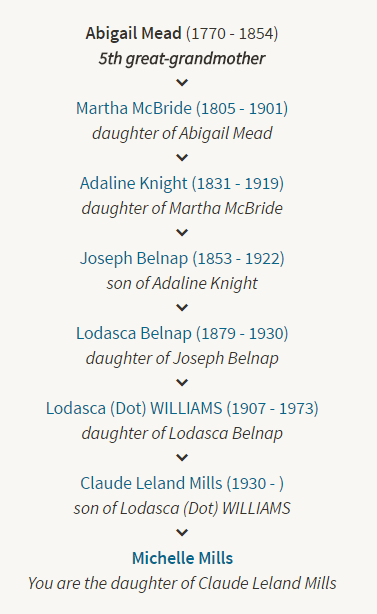
Abigail Mead (1770-1854)


On 25 June 1833 in Villanova, New York, at least three Mormon missionaries—William Cahoon, John F. Boynton, and Evan Melbourne Greene—oversaw the beginnings of a branch of the Church of Jesus Christ. Greene recorded: “We had a meeting to organize the church and the Lord blessed us and two went forward in the ordinance of baptism whose names were as follows: Abbigail & Roxannah McBride” (EMGJ, 23).

When Abigail was seventeen years old she married Reverend Daniel McBride. Since he was an itinerant Campbellite minister, the family, which would eventually include nine children, moved from place to place in order for Daniel to aid the individual churches over which he had stewardship. On more than one occasion he mentioned to his immediate family, “There is something lacking. I feel that I have not the authority as the Prophets of old. If only I could say to the people, ‘Thus sayeth the Lord’” (VK). Lamentably, Daniel died in 1823, ten years before Abigail was baptized into the Church of Jesus Christ.

The day Abigail first listened to Mormon elders is hard to pin down. Missionary Evan Greene noted that it was a “glorious time” as they met with eager listeners in the “McBride schoolhouse” in Villanova, New York, on Sunday, 26 May. Greene “spoke to the [congregation] and testified to them in the gift of tongues and the spirit of God rested down upon us” (EMGJ, 18).

On Tuesday, 9 June Amasa Lyman stayed in the David Crandall home, David being married to Abigail’s oldest daughter, while Greene resided with Reuben McBride’s family, with whom Abigail presumably lived. It was as this point that the families “began to see the need of obeying the commandments” (EMGJ, 21).

The Crandall and McBride households began to be baptized on Thursday, 13 June. The following day at 5 P.M. the missionaries once again held a meeting in the McBride schoolhouse, and part of the McBride family members attended. Several of the listeners “testified to the gospel and rejoiced in the blessing of the Lord in sending his servants into that place.” Still, “others desired us to pray for them that they might be enlightened and come to the knowledge of these things” (EMGJ, 21). Whichever meetings Abigail attended, she was, as mentioned above, baptized on 25 June.

Two years later (1835) many of the McBrides, Crandalls, and Knights—Abigail’s youngest daughter, Martha, married Vinson Knight—traveled to Kirtland, Ohio to gather with the Saints (VK). The following year, on 8 June 1836, at the age of 66, Abigail received her patriarchal blessing under the hands of Joseph Smith Sr. Promised blessings included seeing “angels, and receiv[ing] the communications of the Holy Ghost . . . [and that if she would] “give up thyself to God … thou shalt see thy Redeemer whom thou desireth to know.” While these prophecies were sacred in nature, a more temporal blessing, easily discerned as fulfilled by any individual, was that she would “go to Zion, and be in good health. Thy mind shall be strong and rejoice in thy God” (PB).

Abigail was in good health in body and mind and she traveled to the Great Basin Zion. After Abigail and her family left Kirtland, they homesteaded in Nauvoo, Illinois, and then went to the Great Salt Lake in the Edward Hunter-Jacob Foutz Company from June to October 1847. Abigail, at 77 and the oldest member of her company, traveled with two of her sons, John and Samuel McBride, Samuel's wife Lemira, and her grandchildren, Samuel and Lemira's children, Lydia and Samuel (JH, 21 June 1847, p. 25). During the trip (8 September 1847) the Hunter-Foutz Company and others welcomed Brigham Young and his company as they traveled back to Winter Quarters, Nebraska to oversee trail and sure up Church organization. An impromptu feast was prepared which included “broiled beef, pies, cakes, and biscuits.” Women unpacked good dishes, Edward Hunter provide a “nice fat steer,” and “a dance in the evening completed the festivities.” Eliza R. Snow, who was in attendance, remembered: “I know not as I have set at a table better supplied with the luxuries of life in all my travels for many years than was at this table set at the foot of the South Pass of the Rocky Mountains” (WFTP, 274).

Abigail settled down with family in what is now known as Ogden, Utah and died at the age of 84 on 12 March 1854; she was buried in the Ogden City Cemetery. One of her great-grandsons, Gilbert Belnap, remembered her as a “short, rather stout, fine old lady, with a square face and a fair complexion” (SE). Certainly an outward appearance of “stout” would describe her fortitude and righteousness throughout her life.

Sources:
EMGJ, Evan Melbourne Greene, “Evan M. Greene journal, 1833 January–1835 April,” MS 14339, paginated typescript, available through http://churchhistorycatalog.lds.org/.

JH, Journal history of the Church 1896-2001, CR 100 137, available through http://churchhistorycatalog.lds.org/.

PB, “Patriarchal Blessing of Abigail McBride by Jos. Smith Sr.” www.FamilySearch.org>Abigail Mead [KWV9-4Y1​​]>Memories>Documents.

SE, “Stories of Utah Pioneers: Abigail Mead McBride Was Born In New York in 1770 and Died in Ogden in 1854, After Varied Experiences,” Ogden Standard Examiner [newspaper], 12 February 1933, available at http://www.belnapfamily.org/Ogden_Standard_Examiner_1933-02-12_Stories_of_Utah_Pioneers_(top).jpg.

VK, Lola Almira Belknap Coolbear, “Vinson Knight biographical sketch,” available at www.FamilySearch.org>Vinson Knight [LCRS-2QF​​]>Memories>Stories, “Sketch of the Life of Vinson Knight by Lola Belnap Coolbear.”

WFTP, Richard E. Bennett, We’ll Find the Place: The Mormon Exodus, 1846–1848 (Salt Lake City: Deseret Book, 1997).


Wednesday, May 11, 2016

Melvin "M.G." Crawford (1889-1979)

Melvin was the oldest child in his farming family and “quite large” in height as a boy (2 [refers to page number; see below for source]). Though born in Manti, Utah, he and his family moved away when he was four, only to return as Melvin entered his teens. They returned to Manti from a town called Koosharem—over fifty miles to the south. While Melvin was charged with herding the “cows and horses back to Manti on the … ordinary wagon roads” (1), his father (Gardner), and mother (Sophie), along with two siblings, bustled ahead in a horse-drawn wagon and a team of horses. What took the majority of the family a single day to travel, took Melvin three. Among the mixed herd he led north were “two of the milking cows and whenever it would come night, [he] had to milk the cows on the road, [and] just put on the ground what [he] didn’t want” (1). Both cows and horses grazed on the road side at night when Melvin curled up and went “to sleep with a blanket over [him]” (1). By mid-afternoon on the third day, the tired boy and animals were still some distance from Manti; his “mother got worried about [him],” brought sandwiches, and, Melvin recalled, “she walked along … for quite a little ways” (2). Later, she hurried on ahead to care for the rest of the children and prepare supper. The weary Melvin, who remembered that he “walked the soles off my shoes” on that trip, arrived after dark with the herd (2). Though he does not remember why his dad did not greet him like his mother, this was not the last time his father volunteered the young Melvin for a herding position.

Melvin  (in front of the doorway) and others on a sheep sheering day

Before arriving at the age of sixteen, Melvin remembered, “My dad hired me out to go herd sheep one time” (11). Melvin and his father regularly sheered sheep for a resident in Ephraim—a town less than ten miles from Manti. After the sheering was done, the resident “fellow wanted me to go out on the lambing ground” (11). Melvin protested, “Dad, I can’t go out there, I don’t know anything about herding sheep” (11). Gardner dismissed his son’s inexperience: “All you have to do is drive them [and] go around them just like everybody else. He will be with you” (11).

Soon, with Melvin on a horse, and the experienced sheep herder driving a wagon, they drove the flock from Ephraim to the grazing/lambing ground, which was somewhere between a three to four day ride. Each day started and end the same: drive the herd three to five miles a day, camp, eat and sleep. Once they arrived at their destination, which included a cabin, the man from Ephraim surprised Melvin with these instructions: “I have got to go home now. You stay here and just go around these sheep twice a day. You get up in the morning and go around them, about five o’clock, or just as soon as it comes daylight. You set your clock to get up. Go clear down around the sheep and herd them all back in the middle. Then go back to camp and eat your [lunch]. Then start out again and go clear around them” (11). With that, the sheep herder left. Melvin arose the next day and sought to be obedient to the directions. He found that he traveled about six to seven miles in the morning and then another six or seven in the afternoon. This monotonous schedule continued for ten days.

For a week and a half Melvin was all alone with his horse and the flock of sheep. He found himself afraid and unable to sleep with the sound of howling coyotes. Toward the end of the ten days foodstuff began to run short. He ate everything that was in the cabin: a little bread, pieces of mutton, peas, and a few canned goods—he was willing to kill one of the sheep to survive but he had no idea how to gut and quarter a lamb. Finally, when he was down to “one can of tomatoes left and nobody was there … he came in” (11).  The man laughed and blurted, “I didn’t mean to leave you that long. I got on a big drunk, and I forgot to come” (12). Though the man offered Melvin an evening meal, the boy just wanted to go him. The man counseled Melvin to wait until morning, but the boy “was so homesick that [he] was just about crazy” (12).

Astride a horse, Melvin guided the animal in the direction he thought was south, toward Manti. At one point he was so sleepy that he dismounted and “sat down by a tree and went to sleep” (12). In the morning, Melvin was surprised to see that he was not very far from the lambing ground. The sheep herder observed, “If you had have let that horse go, he would have gone right home” (12). “But I wouldn’t,” Melvin lamented. “I guided him and I just went around in a great big circle” (12). After eating breakfast the herder again instructed, “Just let the horse go and he will take you home” (12). Doing as instructed, Melvin soon arrived in Ephraim at the man’s house—the wife “hooked another horse up to a buckboard and took [Melvin] home” (12). Following this experience Melvin quipped, “That was the experience I had herding sheep. That is all I wanted” (12).

(Source: M.G. Crawford Interview, MSS OH 138, L. Tom Perry Special Collections, Harold B. Lee Library, Brigham Young University, Provo, Utah, paginated typescript of oral interview.)

Wednesday, May 4, 2016

John Crawford (1828-1923)


John Crawford, farmer, of Manti, is one of a family of four and was born in Wickston, Peebleshire, Scotland, September 30, 1828 [or 1829]. His parents were James and Elizabeth (Brown) Crawford.

His father was a flax weaver, making fancy linen cloth. John spent the early years of his life on a farm till he was 16 years of age, and when 14 joined the Mormon Church.

He worked at track-laying on the railroad till the fall of 1849, when he immigrated to the United States, coming across from Liverpool in the sailing vessel Zetlin. The voyage took six weeks and two days and he landed in New Orleans on Christmas day, 1849. He journeyed up the Mississippi River to St. Louis, where he remained the balance of that winter.

In the spring he continued up the river to Kanesville, where himself and [his] brother James rented a farm and put in ten acres of wheat and twenty-five acres of corn. In July Kinkade and Livingston fitted up a train of thirty-five wagons drawn by ox teams to haul merchandise to Salt Lake and John hired out to them to drive one of the teams of four yoke of oxen. They left old Fort Kearney on the Missouri August 3rd., A. O. Smoot, late of Prove, being their captain, and arrived in Salt Lake City September 28th. That winter he worked in Mill Creek canyon at the lower sawmill for Barney Adams.

In the spring of 1851 himself and Alex Cowan took a contract of Bishop Hunter and made the adobes for the old Tabernacle in Salt Lake City, which was the first church built in Utah. It was constructed on the ground where the Assembly Hall now stands. In the spring of 1852 himself and brother James rented the farm of Apostle C. C Rich at Centerville, which they worked for two seasons.

When the Walker Indian war broke out in the summer of 1853 he was one of a com- pany of about thirty-five called by Governor [Brigham] Young to go to Manti to strengthen and support the settlement. They were instructed to sell all their possessions so they would have nothing to return to. This company was gathered from the towns near Salt Lake and our subject made captain. They arrived in Manti the latter part of December, 1853, and found the snow eighteen inches deep. They spent the balance of that winter in standing guard and building a fort.

In May of 1855 he was called with about fifty others upon a mission to the Elk mountains to live among the Indians to try and civilize them. September 23rd the settlement was broken up and they were driven out by the Indians, who killed James W. Hunt, William Behunnin and Edward Edwards and wounded A. N. Billings, the president of the mission. The Indians burned all their hay and stole their cattle.

In 1857 he with Harmon T. Christensen, N. Beach and B. Hall received a charter from the city to construct and maintain a toll road up City Creek canyon. This road they constructed about eight miles and the following year they built a. sawmill in the canyon with a gig saw. They cut from 2000 to 3000 feet of lumber per day, Mr. Crawford being the sawyer. They owned and operated this mill nearly ten years.

When the Temple was being built he ran a lime kiln five miles west of town, burning all the lime used for the Temple for nearly five years. During all these years his family looked after the farm and carried it on successfully. He has been engaged in the cattle and sheep industry and has now a band of about 1500 head of sheep. He is a stockholder in the new Union Roller Mills, was a member of the City Council three terms, Justice of the Peace two terms. . Mr. Crawford has been prominent in the church, being president of the Forty-eighth quorum of Seventies about thirty years and a ward teacher many years. He was married April 6, 1853, to Cecelia, daughter of Nathaniel and Cecelia. Sharp. Their children are Elizabeth J., John, Jr., deceased, Cecelia, James B., Nathaniel, William W., Margaret C, Mary E., Quincy G., Delphia, deceased, and Catherine.

In February, 1856, he married a second wife, Elizabeth, daughter of Gardner and Sarah (Hastings) Snow. Their children are: Sarah M., Mary, deceased, Martha M., Gardner J., George, deceased, Charles C., Ida, deceased, Adelbert D., Nora A., Frank, Grace and Rayfield, deceased.
It may truly be said of Mr. Crawford he has made a success of life, having no capital to start with, he had nothing but his individual effort to depend on. By steady hard work and honorable means he has accumulated a fair stock of this world's goods and has always retained the respect and good will of his neighbors.

(Source: W. H. Lever, History of Sanpete and Emery Counties, Utah: with Sketches of Cities, Towns and Villages, Chronology of Important Events, Records of Indian Wars, Portraits of Prominent Persons, and Biographies of Representative Citizens [Salt Lake City: Tribune Job Printing Company, 1898], 118–120, spelling and paragraphing modernized).

Wednesday, April 27, 2016

Feramorz Little (1820-1887)

In summer 1851, prior to his baptism into the Church of Jesus Christ of Latter-day Saints, Feramorz Little was a contract employee. His job: carry the monthly mail between Salt Lake City and Fort Laramie—five hundred plus miles of desolation, except for a few scattered trading posts and military Fort Bridger.

Feramorz and Ephraim K. Hanks, fellow employee and brother-in-law, departed for the first trip from Salt Lake to Laramie on August 1, with an expected arrival time of the 15th. The inaugural round trip was uneventful except for enormous 13 inch long bear tracks found one morning, prints which were not there when two postman retired. Yet a trip about a year-and-a-half later, was anything but uneventful.

On 1 November 1852 Feramorz was paired with a Frenchman from Canada named David Contway to complete the postal circuit. It started like any other normal winter run: cold with a timely arrival by the middle of the month in Laramie. Unfortunately severe snowstorms delayed mail delivery from the east until the 25th, and when it finally arrived, an awkward mounting of a mule left Feramorz with “his ankle out of joint” (23). The fort’s army surgeon begged Feramorz to stay and recover: departure in blinding snow storms and in his condition was a death wish. Yet, Fannie, Feramorz’s wife, was waiting, and he would not be restrained. Fannie, was pregnant with their third child and due shortly; he was anxious to leave Fort Laramie and be by her side.

Feramorz and David petitioned help from an Indian named Yodes to guide them on the arduous return journey. (Yodes was an expert guide and able to provide assistance across the extremely snow covered wilderness.) In ten days, probably around the 5th of December, the three companions and some mounts traveled about 110 miles to Devil’s Gate; once there they were warned by owners of a trading post to stop and wait for the trails to clear, going on was “useless” (23). Two nights out from the trading post, with a winter storm raging, David thought about turning back to Devil’s Gate: “Mr. Little, you are going on, are you?” Feramorz resolutely stated: “Yes, I am going on.” Feramorz offered a horse if he wanted to return, but David ultimately decided, “I can stand it if you can” (24).

As the party continued on to the next trading post in Green River—a distance of about 130 miles—Feramorz struggled along on his lame leg, with the biggest difficulty being the use of a crutch once off the mount; the threesome found little to burn, though they once dug six feet to the ground to start a fire; they at times slept peacefully under buffalo skins, blankets, and a top layer of falling snow which served as insulation; and the horses and mules found bunch grass to sustain them.

When they arrived in Green River Feramorz’s “leg had improved and here he threw away his crutches” (26). The advice from this trading post owners was more discouraging than the last, considering fresh evidence: failure is assured; recently two men left with five ponies; they made it 25 miles before three of the ponies died; the two men walked back with the two remaining, exhausted mounts. Once again, David hedged, but once again “decided that he could endure as long as Mr. Little, and concluded to stay with him” (27). Two days before Christmas the trio began the approximate 50 mile trek to Fort Bridger. Since Feramorz no longer needed crutches the company walked, saddled horses cut the snowy trail with the men and pack mules behind, and mail bags drifting down the icy river in waterproof bags. Such a routine prevented animal exhaustion, an example of which they saw when the passed the remains of what could only have been that of a pony lost by the previously mentioned party of two.

Fort Bridger offered a welcome, albeit brief, respite. The party also increased in size. Military man, Major Holman, and his three assistants, and two gentlemen, James Gammell, and Robert Holliday, tired of cabin fever, asked to join the trek to Salt Lake—their courage apparently revived by the success of the determined party of three. On the first day of the final leg of the journey (approximate 100 miles) a fine snow fell with intensely cold temperatures. Feramorz knew the temptation in those circumstances: build up and stand around large campfires. To do so, he warned, would only make them more miserable and cold. They disregarded the tip. (Notice the irony: Feramorz did not heed the warnings of the army surgeon and trading post owners.) “Large fires were made and the clothing on the side of the body next to the fire soon became saturated with melting snow.  As that side was turned from the fire the clothes froze hard, and by this change of alternately freezing and thawing, the outer garments became such a cake of ice that it could not well be gotten rid of.  By getting into bed in this condition the heat of the body would thaw the ice and thus thoroughly water-soak both clothing and bedding, making the future far more uncomfortable than the present” (29–30).

The next morning, “with outer garments so stiff with ice that it was difficult to get into their saddles without breaking the cloth” (30), the group determined to return and recover from their conditions at Fort Bridger. Though frustrated by the delay, Feramorz’s softened his protest when he learned that two Flat-head horses resided in the fort which could be purchased by the party—Flat-head horses were “raised in a country where snow fell deep in the winter,” and capable of great distances and privations in such conditions (30). After the nine men returned, rested for a day, and purchased the horses, which raised the level of mounts to sixteen, they set off for Salt Lake Valley again.

Within two weeks the party reached Echo Canyon, 30 miles east of the valley. Major Holman and his three assistants halted their progress and wintered with a Lewis family in the vicinity. Further, the horses, even the flat-heads, were deemed unfit to make it the rest of the roughhewn way—they were left in the canyon until the spring. The nine remaining men, dragging 140 pounds of mail and essentials, continued.

Now January 1853, things were desperate. The next five miles up the East Canyon Creek to the foot of Big Mountain were daunting. Feramorz’s ankle caused him severe pain, having no horse to carry him—his gimpy gate regularly caused a chuckle to slip from Yodes’s mouth (35). Upon arriving at the foot, James Gammell, his “beard and face nearly covered with icicles,” determined sit, relax, and camp (33). This course was folly—their physical conditions, lack of mounts, and slim provisions warranted continued progress over the mountain that day. Feramorz took the lead in preventing respite. He circumspectly asked Yodes to “get a switch from a tree” and “wake up” James. With a “grin of satisfaction,” Yodes whipped James across the legs. Aroused, James made for Yodes, but the Indian side-stepped and “put in occasional doses of the switch.” Feramorz continued to incite the beating by calling out: “Wake him up Yodes!” Fury raging and expletives erupting James blood boiled, and saved his life.

Though the party did not make it to Salt Lake the day of the whipping, they did make it to a point on the opposite side of the mountain where snow was easily cleared and a roaring fire blazing—they spent “the night [in] the best possible advantage” (33–34).

With seventeen miles left, no further shelter in sight, laborious foot travel required, and very minimal necessities, the company determined to make the drive for the valley in a single day. The mail was left to be retrieved later. Despite his pain, Feramorz blazed the trail in the soft, with the discomfort rising once they began walking across hardened paths and roads.

By the end of the day, 20 January, the company arrived. Feramorz recovered for two weeks in his home, which recovery included the arrival of baby girl Juliette on the 23rd.

Though Feramorz’s mother and oldest brother joined the Church in 1832 with Brigham Young’s family in Mendon, New York, Feramorz did not. In fact, he was not even with his mother in that year. His father died prior to the families contact with the Church, and his step-father’s “hard treatment” influenced Feramorz to live with a Chamberlain family elsewhere (11–13). Though Feramorz had occasional contact with his blood relatives, including an extensive visit in Nauvoo, Illinois, in the fall of 1844, he did not join the Church. After his marriage to Fannie in 1846 their paths led to Salt Lake City in eventual hopes of reaching California and the fair fortune and opportunities it provided. Yet in 1853—the year the trying trip from Laramie concluded—Feramorz softened his heart sufficiently that he accepted baptism into the Church and remained faithful the rest of his life (14–35).

(Source: James A. Little, Biographical Sketch of Feramorz Little [Salt Lake City: Juvenile Instructor, 1890], 1–35, as summarized by Matt Crawford, 3rd great-grandson; mileage approximations used by using “as the crow flies” found at https://www.freemaptools.com/how-far-is-it-between.htm).


Tuesday, April 19, 2016

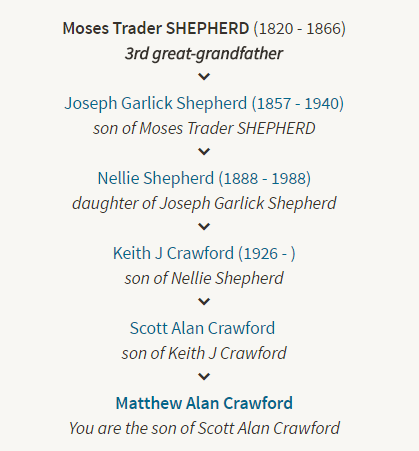
Moses Trader Shepherd (1820-1866)

While living in Indiana, Moses Trader Shepherd was baptized a member of the Church of Jesus Christ of Latter-day Saints in November 1846 by Benjamin Clark (MTS, 114). His wife, Eliza Jane Adamson, did no share her husband’s convictions and refused to follow the Mormons to the west. Without his wife and two living daughters—the couple’s 2 boys die as infants—Moses headed west and arrived in Kanesville, Iowa at least by January 1848 (MTS, 116, 118). In February 1848 Moses was introduced and accepted the law of plural marriage and wedded Martha Amanda Bryant in Winter Quarters, Nebraska. Understandably, Moses missed Eliza Jane and his daughters, so he returned briefly to Indiana and asked them to join him in Nebraska. Despite opposition from Eliza Jane’s family she consented, the Shepherd’s sold their Indiana farm, and settled briefly in Kanesville. Upon arriving, Moses learned that Martha and the baby boy she bore both died during the labor or delivery (MTS, 118).

On 9 August 1849 Moses and Eliza Jane welcomed a boy into their family of five, Aaron Adamson Shepherd. Though not listed on any official roster, the family ventured from Kanesville to Salt Lake City in 1852—lamentably a son, Peter, was stillborn and buried on the trail in the summer of that year (MTS, 122, 126).

By the end of 1852 Eliza Jane was baptized, the Shepherds welcomed another girl to the family, and they were assigned to settle in the Palmyra settlement, now known as Spanish Fork (MTS, 128). Eventually Eliza Jane and Moses would have three more sons, and another girl, Moses would enter plural marriage with two more women (MTS, 139–140, 144, 147, 150–151).

One son, Joseph Garlick Shepherd (our 2nd great-grandfather), recalled specific incidents while living in Spanish Fork: “I remember well one time when an old Indian by the name of John came to our house and wanted to borrow my mother’s skillet. Mother was using it and she told him that he could take it when she was through with it. Perhaps you do not know what a skillet is- so I will explain; it is a large round iron pot, flat on the bottom and about 10” high and about 14” across the bottom. It also had a lid that fight tight on the top. Mother used to bake her bread in this skillet….

“When my mother told the Indian that he couldn’t have the skillet right then he got angry and wouldn’t talk anymore. This is the manner of most Indians when they are angry. Father had dug a potato pit the year before and it was empty now, except for some old straw that covered the bottom of the pit. The Indian named John crawled down into the pit and stayed there all night. Father had to stand watch all night for fear he might try to harm someone or do some damage. But, in the morning, he crawled out and left.”…

“Another incident that happened before my father died comes to my mind now, so I will relate it. An Indian by the name of Tintic came to our house and wanted to borrow Father’s gun. It was a gun that was loaded at the muzzle and a very fine gun at the time. Tintic told father that he wanted to borrow his gun for two sleeps, which means two days and two nights. Although father needed his gun, he told Tintic he might borrow it if he would be sure to bring it back in two sleeps. When two days and two nights had passed Tintic returned with the gun and said he wanted to borrow it for three sleeps more. But father told him he needed the gun and would not let him take it again. At this Tintic got very angry and said he would take the gun anyway.

“Father took hold of the gun in an effort to take it from the Indian but they were pretty evenly matched and they struggled for at least a half an hour before Father finally got the gun away from the Indian. Tintic was very sullen and refused to talk anymore so father gave him the gun and Tintic went up the river to the farmhouse. Father went up to the farmhouse the next morning and talked to the Chief whose name was Mountain. He told Mountain of the incident of the day before. Since Mountain honored Mr. Shepherd’s word, he got a good raw-hide whip from his tent and said to Father, ‘Come with me.’ They went from tent to tent until they finally found Tintic lying on the floor of the tent. Mountain ordered him to come outside, but Tintic was so stiff and sore from the scuffle of the previous day that he found it very difficult to rise from the floor and get out into the open. Once outside the tent, Mountain gave him a severe whipping with the rawhide whip, and returned the gun to Father” (MTS, 227, 148).

Moses lived a rather short life (1820–1866), his trade was simple (farmer), and his features simple (dark complexion), but his posterity follows his example in the area that matters most: maintaining membership in the Church and faithfulness to the Lord and His prophets (MTS, 150).


(Bliss J. Hansen, comp., Moses Trader Shepherd: His Family and His Ancestors [Provo, Utah: B.J.B. Hansen, 2005], [MTS] available on FamilySearch.org at https://familysearch.org/search/catalog/1324094?availability=Family%20History%20Library). 

Tuesday, April 12, 2016

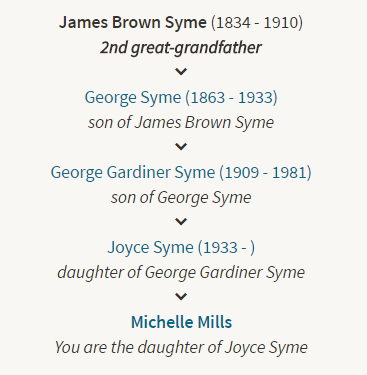
James Brown Syme (1834-1910)

                                                                   
James Brown Syme was born 26 August 1834 in Stobsgreen, Edinburgh, Scotland. His temperament blossomed as a full Scot by adulthood. One grandson remembered: "Grandfather Syme lived with us for some time. He was quite stern and was always telling my mother that she should give me a good strapping. I remember getting quite a few lickings from my mother and I guess that I deserved most of them" (ACSJ). A granddaughter recalled his "straight forward . . . speech, which could be very biting." Although, if he did not like anyone, he would not backbite; instead, "he just left them alone." Yet if, when playing checkers, the house was not completely quiet, he would growl "sternly" at the "boisterous" grandchildren, "uttering either one of two expressions: 'By the powers/By the flames, if you don't sit down, I'll knock you down'" (JBS). His Scotish character did not just produce fierce words and a fiery temper, once he joined The Church of Jesus Christ of Latter-day Saints he firmly defended the truth until he died.

As an adult James Brown Syme measured 5 feet and 11 inches tall, 160 pounds, and a chest of 44 inches. His eyes were blue, his hair dark--albeit when he got older it went white, and he grew a flowing beard to go with it. James married Margaret Livingston Haldane on 3 July 1857. The union produced 12 children. By mid-May 1863 James and his wife joined the Church, and he was appointed the presiding elder of the local branch. His ecclesiastical duties sidled next to his employment as a coal miner in Haywood, Scotland--the residential area of the Symes. He found enjoyment and relaxation through fishing and hunting; he raised and loved "greyhound hunting dogs," especially a girl, bluish in color, that he called, "Nellie"; he was a fine marksman: "he could step off twenty steps and shoot the clothes line in [half] with his" 22-caliber rifle (JBS). Despite recreation, family, and fruitful employment, "after joining the Church, all thoughts turned to traveling to Zion" (JBS).

James and a son-in-law left Scotland in 1880 and immigrated to Almy, Wyoming, where James worked in the coal mines. By the end of 1881 money was sufficient for the entire family to relocate to Wyoming. In 1886 the family moved to Wellsville, Utah, which allowed them to receive the sealing ordinance in the Logan Temple. But in 1888 the family once again moved back to Wyoming and resided in the town of Rock Springs--where James once again presided over a branch of the Church (JBS). James staunchly honored the Sabbath day and his spiritual gifts developed as he matured.

One morning before working in the mines in Wyoming he "received the impression that he should not got to work. He obeyed. . . . There was an explosion in the mine that day." A similar experience occurred when he dreamed one night that the mine experienced a cave in; as before, he did not go to work, but the following day returned and found his dream fulfilled. One of his daughters, Mary, was a sickly child. "It seemed as though every time . . . she would have a bad spell, even when [James] was at work, he knew. He would go home immediately and administer to her. She would recover for a time." His youngest daughter, Jane, recalled dying, but being "brought back" through her father's priesthood administration (JBS). He even healed those outside his family circle.

"James and a Brother Voss were called to Mountain View, Wyoming, to administer to a young girl, Ida Johnson, who had been struck by lightning. When they arrived at the home the girl lay on the bed seemingly dead. Many people, [who were smoking and using foul language, came] from [the surrounding ranches] . . . came to the home. [Thus, the scene which greeted the two elders was one of smoke and verbal filth. James] said to Brother Voss, ‘The spirit of the Lord can’t enter this home full of tobacco smoke.’ They did administer to her, but to no avail. They left the home and went to the river bank where the willows grew thick and there they knelt and prayed to the Lord. When they arose to their feet something told them to go back and pray over the girl again. They requested all the people to leave the home except the father and mother of the girl. [One wonders how "nicely" the Scot asked them to vamoose.] After the people left they again administered to the girl. In just a few minutes she opened her eyes and soon began to talk to them. In a short while she was able to sit up in bed, and before the day was over she was up walking around."

James lost his wife in 1891 and he passed away in 1910. They are buried side-by-side in Rock Springs, Wyoming.

 (“Autobiography [Early Years] of Cecil Syme James [1900-1988] - written in 1979” [ACSJ] www.FamilySearch.org>James Brown Syme [KWJC-6CH]>Memories>Stories; Viola James Reese, "James Brown Syme" [JBS], www.FamilySearch.org>James Brown Syme [KWJC-6CH]>Memories>Documents).

Thursday, April 7, 2016

Jane Gardiner (1867-1959)


Jane Gardiner was born in Bankend, Lanark, Scotland on January 16, 1867. She belonged to an extremely poor family of 11 children. By the time Jane was 8 she was already working at the mills. By age 12 her parents made her an indentured servant to a family headed to the United States—the passage was uncomfortable for the girl because she was forced to sleep in the ship’s steerage compartment.

Jane and the family settled in Little Red Stone, Pennsylvania. At age 16 Jane married 22-year-old William Bennett Rae. By the end of 1887, after about 4 years of marriage the couple had two children and joined The Church of Jesus Christ of Latter-day Saints. Their conversion led them to move to Rock Springs, Wyoming, so as to be nearer the Church headquarters in Utah. While the family of 7 people—5 children and the parents—continued to reside in Wyoming, they were sealed in the Logan Utah Temple on December 4, 1889.

Lamentably, William abused Jane, and more than likely the children. Even so, or perhaps, mercifully, the Lord called him on a mission to Texas around 1901. While there William wrote that he had received a revelation: he had taken a second wife in order to live the law of plural marriage. Understandably this did not sit well with Jane, particularly since President Wilford Woodruff publically issued the Manifesto in 1890, a document rescinding the previous command of polygamy. Jane was committed to the Church and obedience to the prophet—she divorced William, and he was excommunicated in 1902.

Jane would occasionally reminisce about the trials of providing for herself and her 4 living children—1 of the children lived less than a year. With a prayer for help, one night Jane fed her children the last bite of food in the house and put them to bed knowing that she did not have any food for their breakfast. That night a man pulled into her yard and asked if he could stay in her barn. She mentioned that she had no food to share, but that he was welcome to the barn. The man commented that she was in luck, he had food to share with her and the children.

On November 25, 1902 Jane civilly married George Syme, who loved, provided, and protected her and all of the children, including the 2 children the union produced. The family was eventually sealed on September 16, 1908, after successfully obtaining a cancellation of sealing between Jane and William. Though George deeply desired to provide for the family, his work as a coal miner led to the contraction of Black Lung disease, which impelled him to purchase a small farm in Logan, Utah by 1917. Jane lost her sweet George in 1933, and she moved in with her son and his wife, George and Thelma Syme.

Descendants of Jane remember her good cooking, especially of pies, and a never-say-no-to-a-church-calling attitude. Joyce Syme Mills, daughter of George and Thelma, recalled Grandma Jane taking care of the children because both George and Thelma worked outside the home. Jane escorted the children to church activities, the movies, up to Wyoming during the summers to visit Florence (Jane’s daughter) and her husband, and over to the Uinta Mountains to camp, and fish.

Jane was able to visit her parents and siblings twice in Pennsylvania before she died on March 26 1959. Yet, her death does not mark the end of remembering. Jane’s patriarchal blessing promises that “thy children and thy children’s children shall hold thy name in honorable remembrance from generation to generation.” Not only does this brief life history serve to honor her, but her great-great-great-granddaughter, Jane Crawford (daughter of Michelle Mills Crawford, who is a daughter of Joyce Syme Mills), was named after Grandma Jane.


(Sources: Joyce Syme Mills, “History of Jane Gardiner,” as found on www.FamilySearch.org>Jane Gardiner [KWZQ-SNX]>Memories>Documents; Patriarchal Blessing of Jane Gardiner, available through the Church History Library of The Church of Jesus Christ of Latter-day Saints.)